Entity details
Confirm the legal entity, prior names, departments, known municipal addresses, and staff contact. We use those inputs to cluster records and score listed addresses against known municipal addresses.

A managed municipal workflow
We use data science to assess possible matches, organize evidence and required documents, file authorized claims, and monitor the live registry—so your team has an accountable process and no public dollar sits idle.

The recovery process

We collect the State Treasurer’s main unclaimed-property records and separate insurance file class, then monitor the live registry for the municipality’s legal name, former names, departments, authorities, and approved variants.
We parse property identifiers, owner strings, holder fields, and listed addresses; cluster possible records by municipal department; and score addresses against known municipal addresses.
Property identifiers take priority over name patterns. We assess the main records and separate insurance file class, reconcile candidates with the live registry, and label each qualified record with its source and confidence before building its evidence and document checklist.
Your team reviews the qualified findings and per-claim checklists, completes its approval process, and signs the written agreement and special power of attorney required for representative filing.
We assemble the documented submission under OAC 735:80-7-2(b)(13). On a recurring review cadence, we monitor claim status, Treasurer questions, document requests, and changes to the source record; respond as needed; and keep the municipal contact informed.
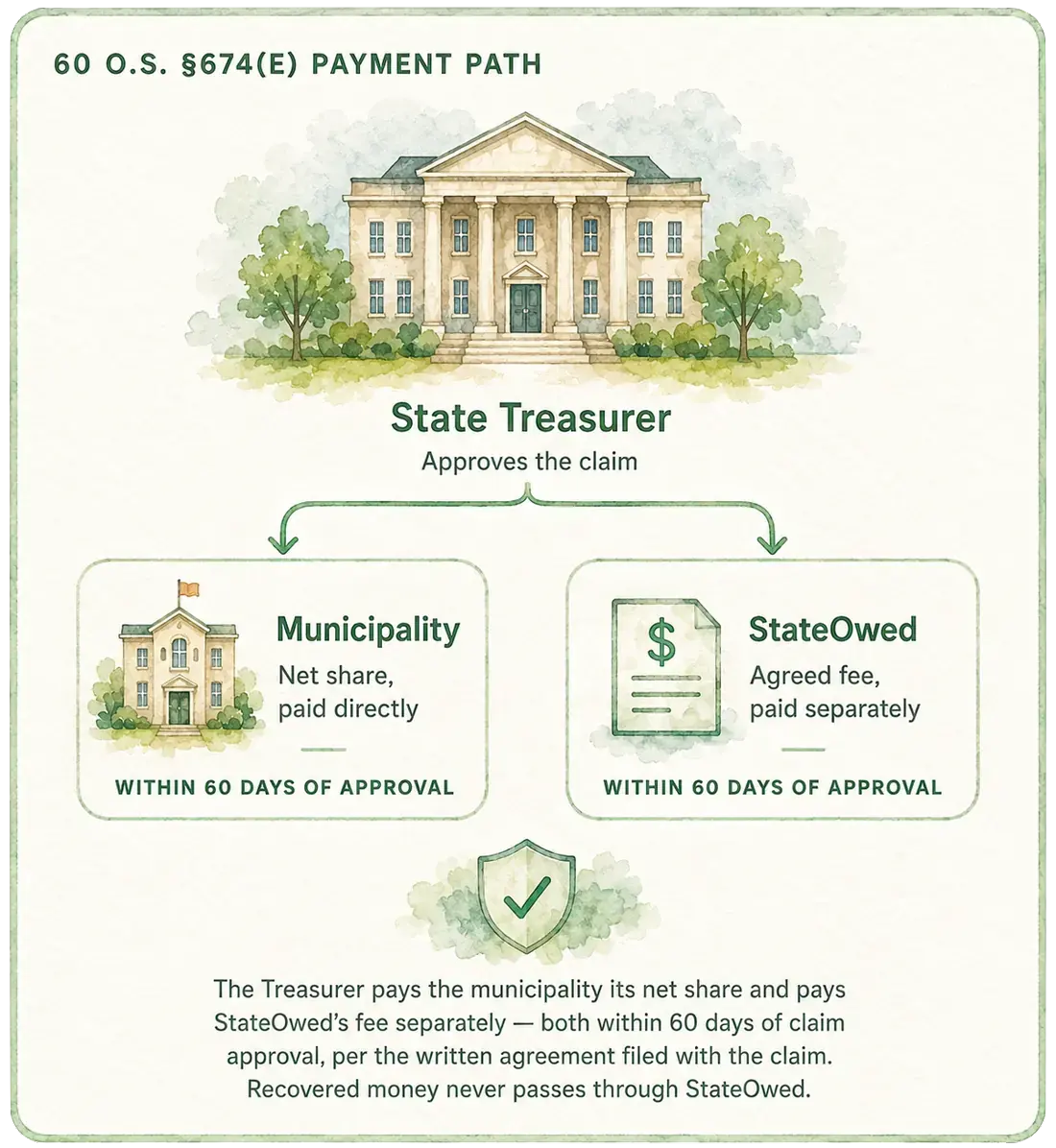
If the claim is approved, we reconcile the decision and payment status with the claim record. The Treasurer pays the municipality its net share and pays StateOwed’s agreed fee separately under 60 O.S. §674(E), both within 60 days of approval, exactly as the filed agreement states.
After the initial recovery, we rerun approved entity names, variants, departments, and address patterns across the main records and insurance file class, then reconcile new candidates with the live registry. We assess and organize qualified property, then prepare and file under the continuing authorization—so no public dollar sits idle.
What your team provides
Confirm the legal entity, prior names, departments, known municipal addresses, and staff contact. We use those inputs to cluster records and score listed addresses against known municipal addresses.
Provide the authorizing and ownership records only the municipality can supply. We organize them against a per-claim evidence and document checklist.
Route the agreement and special power of attorney through the required approval process. Written authority lets us file and monitor the claim on the municipality’s behalf.
Ongoing coverage
The written agreement defines the service, contingency rate, authority, and termination terms. While it remains active, we reconcile approved municipal names, variants, departments, and known addresses against the live registry; assess new listings; organize the claim record; and file qualified property under the continuing authorization.

Protected payment path
Before filing, we organize the source record, ownership evidence, required documents, and written authority into a per-claim checklist. That documented claim record stays with the work through state review.
Under 60 O.S. §674(E), the Treasurer deducts the representative fee and pays both parties directly: the municipality receives its net share, and StateOwed receives the agreed fee separately. Both payments are made within 60 days of claim approval, exactly as the written agreement filed with the claim states.
Recovered money never passes through StateOwed, and your city never has to process our invoice. No recovery means no fee.